
Water doesn’t wait.
Neither do we.
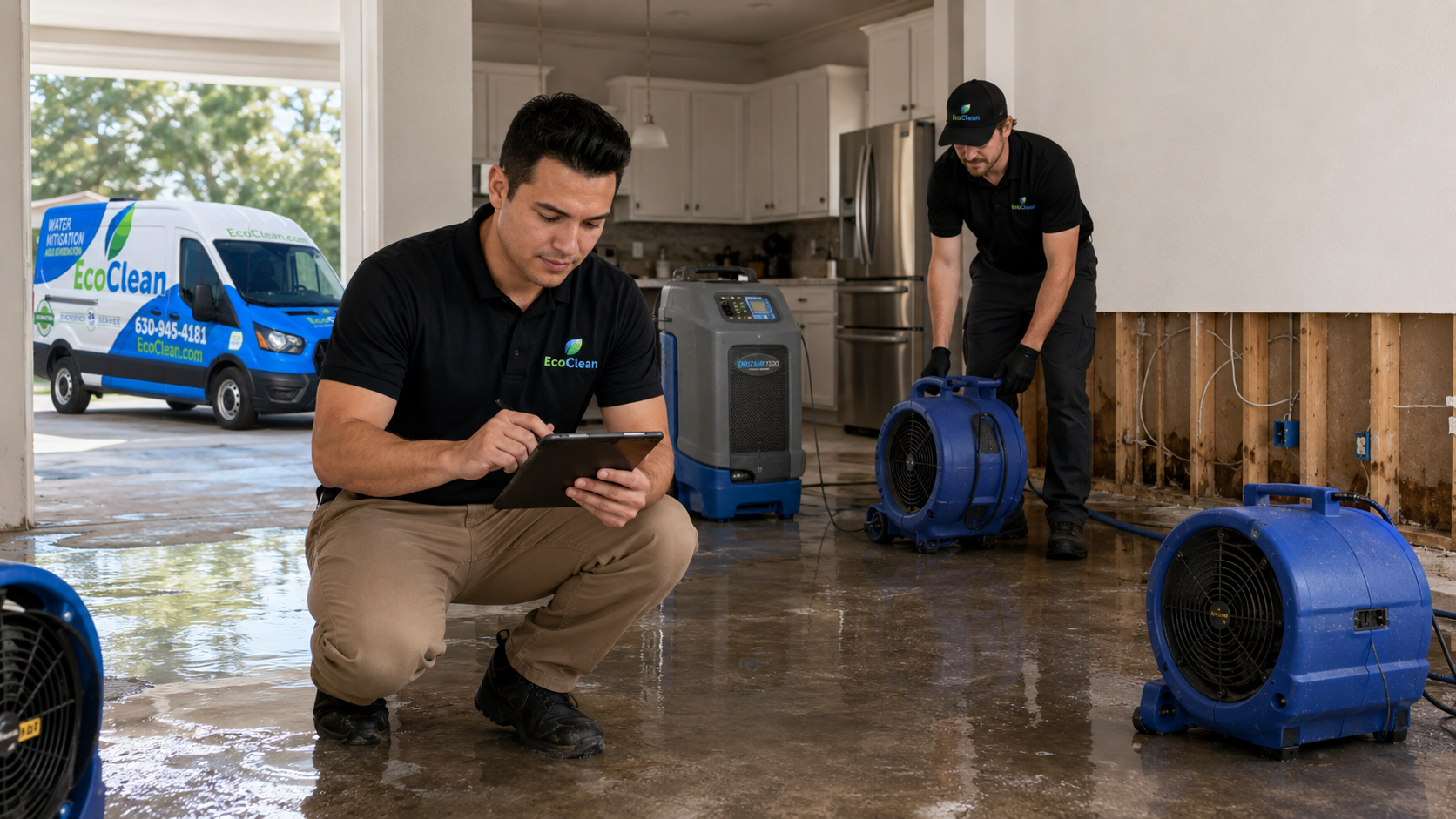
Floods, burst pipes, sump failures, sewer backups, hidden moisture. A project manager is on site in 60–90 minutes, day or night, across Chicago and all surrounding suburbs — and you’ll know the scope and the price before any work starts. Then one team carries the job from extraction through finished reconstruction and bills your insurance directly.
Free estimate. No-obligation site visit. We bill your insurance directly. 1,600+ Google reviews · 4.9★.
What water damage restoration actually is.
Water damage restoration is the controlled recovery of a building after water enters where it shouldn’t. The work runs in two phases: mitigation (extraction, containment, structural drying, daily moisture readings) and reconstruction (drywall, flooring, paint, trim). EcoClean handles both with one team so the insurance file stays clean and the job finishes without surprises.
Mold can start growing on a wet porous surface within 24-48 hours — fast extraction matters more than thorough scrubbing later.
Water damage is classified by category (Cat 1 clean, Cat 2 gray, Cat 3 black) and class (1-4 by saturation extent). The combination drives the drying scope.
Sudden and accidental water losses are usually covered by homeowner policies. Sewer and sump backups need a separate Water Backup endorsement. Long-term seepage is generally excluded under any homeowner policy — which is why fast response matters.
Drying is verified with meter readings, logged daily on a signed dry-out log — the documentation insurance companies expect, and what tells you the job is actually done.
Demo before drying is rarely the right move. Selective flood cuts only happen where insulation is saturated past the salvage line.
Plumbing failures need a plumber; the building drying out needs a restoration company. Most jobs need both, working in parallel.
Reconstruction is its own phase. EcoClean rebuilds with the same crew that handled the dry-out, which keeps the insurance file clean.
One company. Extraction through rebuild.
Drying out is the easy half. The hard half is the paperwork, the contents, and the reconstruction. We carry all of it.
- 01
Site walk + thermal imaging
We map the actual wet footprint with thermal imaging and moisture readings before any demo — no opening walls just to look around.
- 02
Water extraction
Truck-mounted and portable extractors pull the standing water out fast — before it migrates into walls, subfloors, and cavities.
- 03
Containment when needed
Cat 2/3 losses get poly-sheeted containment + HEPA scrubbers so contamination doesn't spread to dry parts of the building.
- 04
Structural drying
Commercial dehumidifiers + air movers sized to the job and calibrated against the moisture map.
- 05
Moisture monitoring
Daily readings on every affected material — drywall, framing, subfloor — logged on a signed dry-out log in the format insurance companies ask for.
- 06
Cleanup + antimicrobial
EPA-registered antimicrobial applied during dry-out so a water loss doesn't quietly turn into a mold job in two weeks.
- 07
Documentation
Time-stamped photos, moisture logs, signed authorizations, written scope — the package adjusters expect.
- 08
Reconstruction
Drywall, paint, flooring, baseboards, finish. The same team that dried the building rebuilds it.
Cat 1, Cat 2, Cat 3 — and why it changes the scope.
The water category drives whether materials can be cleaned in place or have to come out, and whether PPE and containment are needed. The longer water sits, the more it shifts toward a higher (worse) category.
Category 1 — Clean
Clean water from a sanitary source (supply line, water heater, appliance inlet) that hasn't yet contacted contaminants. Most materials dry in place when caught quickly.
Category 2 — Gray
Significantly contaminated — dishwasher discharge, washer drain water, aquariums, toilet overflow with urine. Capable of causing discomfort or illness on contact. Porous materials are case-by-case.
Category 3 — Black
Grossly contaminated — sewage, rising flood, sewer backups, any water carrying pathogens. PPE and containment are required. Porous materials are generally discarded.
Class 1 through Class 4 — how saturated, how hard to dry.
- Loss class
Class 1
Smallest scope. Slow evaporation rate, minimal materials saturated. Often a contained kitchen or laundry leak caught quickly.
- Loss class
Class 2
Larger scope. Faster evaporation rate, substantial wet-material area including carpet and pad. Drywall wicked up the wall a foot or more.
- Loss class
Class 3
Greatest scope. Fastest evaporation rate, water from overhead — ceilings, walls, insulation, and floors all in play. Many overhead losses fit here.
- Loss class
Class 4
Specialty drying. Saturated low-permeability materials (hardwood, plaster, concrete, masonry) that take much longer to release water. Mat-drying and desiccants get used.
The tools that move a wet building back to dry.
Air movers
High-volume, low-pressure fans aimed at wet surfaces. They accelerate evaporation — the first step of structural drying.
Dehumidifiers
Refrigerant-style LGR units and desiccant units. They pull the evaporated water out of the air so it doesn't re-condense on dry materials.
Moisture meters
Pin and pinless meters that tell us when a wall, framing member, or subfloor has actually returned to dry. Readings live in the daily drying log.
Thermal imaging
Infrared camera scans that spot temperature anomalies pointing to hidden moisture. Always paired with meter readings — thermal alone isn't a moisture reading.
If your situation looks like one of these, you’re in the right place.
Flooded basement
Finished or unfinished — extraction, structural drying, contents handling, then rebuild.
Burst pipe
Shut off, extract, dry — documented start to finish in the format insurance companies ask for.
Sump pump failure
Often hits at the worst moment. We arrive same-day, dry the space, and document for the claim.
Toilet or supply-line overflow
Category 2 water — needs antimicrobial, careful demo, and proper documentation.
Storm or roof intrusion
Water in attic, ceilings, exterior walls. We trace the path and dry the building envelope.
Hidden moisture
Slow leaks that show up as soft drywall, warped flooring, or musty smell. Thermal imaging finds them.
Five steps from wet to finished.
- Step 01
Call answered
Day or night. A human, not a queue.
- Step 02
Free inspection
A project manager arrives in 60–90 minutes. You approve scope and price before any work starts.
- Step 03
Mitigation
Extract, dry, document. Daily readings.
- Step 04
Adjuster meeting
We meet your adjuster on site. The claim stays in your name.
- Step 05
Rebuild + closeout
Drywall, paint, floor, finish — same team.
Two different jobs. Most homes need both.
A plumber stops the source — fixes the burst pipe, replaces the water heater, clears the sewer line.
A restoration company handles everything after — extracting, drying, documenting, and rebuilding the affected materials.
Most water emergencies need both, working in parallel. We coordinate with whichever plumber you bring in.
One job, two phases.
Mitigation is the emergency phase — extraction, drying, daily moisture readings, scope documentation. Insurance companies expect this within 24-72 hours of the damage.
Reconstruction is the repair phase — drywall, paint, flooring, trim. Starts only after the structure is measurably dry.
EcoClean handles both. Your insurance company sees one scope from mitigation through closeout — which removes one of the most common causes of delay.
A complete file removes the most common cause of claim delay.
When a claim stalls, it’s usually because the file is thin. We build a complete file the first time, in the format insurance companies ask for — and most homeowners never pay more than their deductible.
How we handle claimsTime-stamped photos at arrival
Pre-mitigation state captured before we touch anything. Your insurance company sees what we saw.
Daily moisture readings logged
Hygrometer + Protimeter data on every room, every day, signed and dated.
Direct adjuster communication
We meet your adjuster on site, negotiate our own scope and supplements, and follow up so you don't have to translate.
A scope that matches the damage
We write the scope from the moisture map and the photos — nothing padded, nothing missing.
Water Damage Claims Handled the Right Way.
We work with every carrier.
These are some of the carriers Chicagoland homeowners call us about most often.






Your project manager handles the claim process with you.
EcoClean's project managers guide the job from the first water damage cleanup and dry-out through the insurance documentation and reconstruction process. We photograph the damage, take moisture readings, document the scope, and bill using specialized insurance estimating software so the claim file is organized from the start.
- Photograph the damage at arrival, before mitigation starts
- Take and log moisture readings on every affected area
- Document the scope room by room as work progresses
- Use specialized insurance estimating software for the bill
- Communicate clearly about what was found and what comes next
See the job, documents, photos, invoices, and packet in your portal.
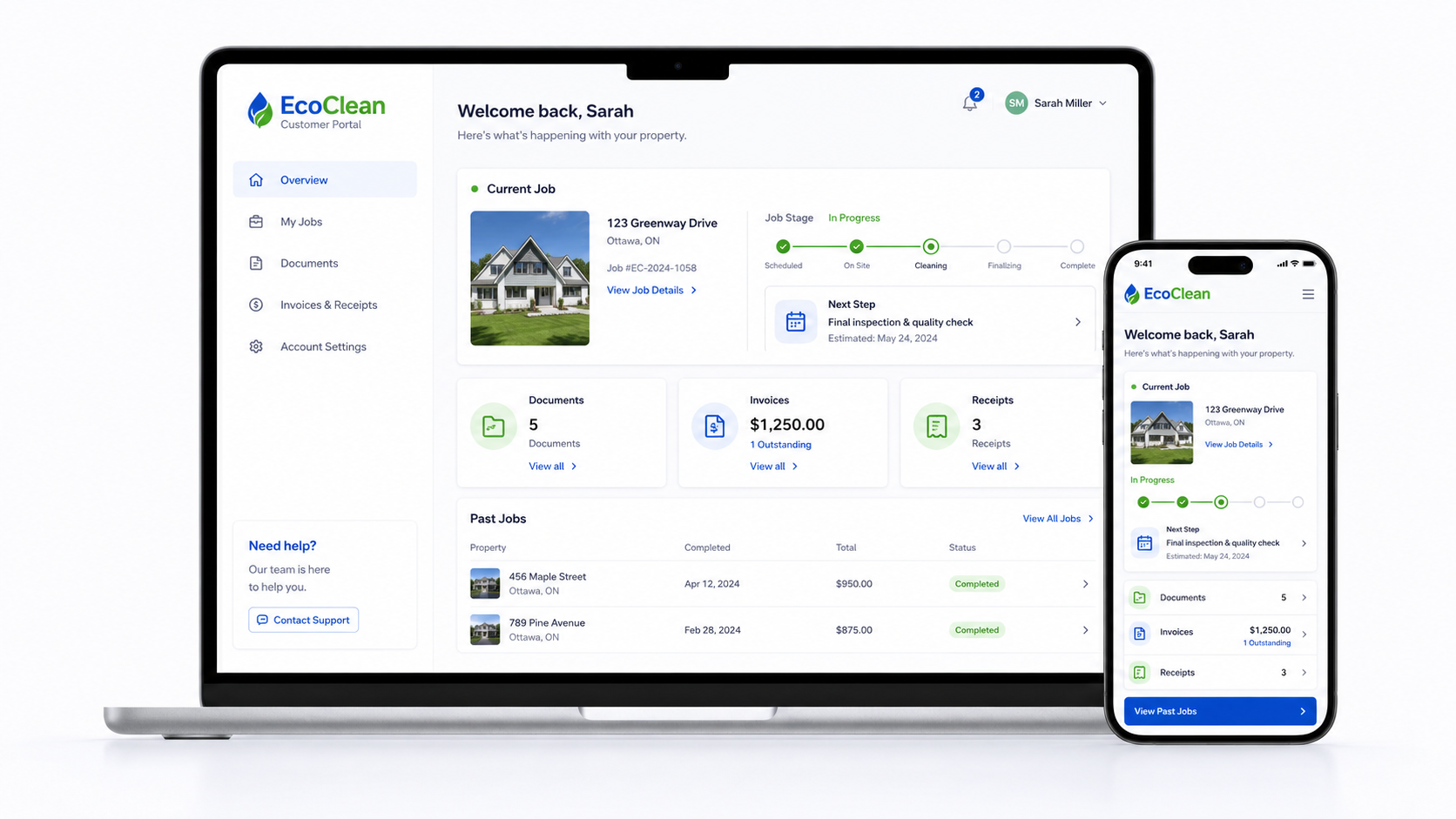
Your EcoClean customer portal keeps the project organized in one place. You can see the current job status, shared documents, job photos, invoices or receipts, and download a project packet when you need everything together.
- Current job status
- Shared documents
- Job photos and media
- Invoices and receipts
- Downloadable project packet
By cause of loss.
Different sources, different field responses. These pages walk homeowners through the most common water-damage causes EcoClean sees across Chicagoland.
- Cause
Burst pipe
Pressurized supply line failure. Fast onset, large volume, common in winter freeze events.
Open guide - Cause
Sump pump failure
Groundwater the pump should be discharging is collecting in the basement instead.
Open guide - Cause
Sewer backup
Category 3 (black) water flowing the wrong way through floor drains, toilets, or standpipes.
Open guide - Cause
Water heater leak
Tank corrosion, T&P relief discharge, or supply line failure. Often discovered hours after onset.
Open guide - Cause
Appliance leak
Dishwasher, washer, refrigerator ice-maker. Tracks under the unit before anyone sees a puddle.
Open guide
Walk through it before you call.
The decision tree below mirrors the triage EcoClean walks customers through over the phone — stop the source, stay safe, document, then call.
Water damage — what to do right nowDirect answers before you decide.
Restoration terms, in plain English.
These are the words insurance companies, adjusters, and restoration crews use day to day. EcoClean’s glossary explains each one in plain English.
Open full glossaryWhat gets wet, and what gets saved.
Salvage decisions depend on the room and the material. Each page walks through what EcoClean evaluates in the field — what can usually be dried in place, what tends to come out, and what to expect after the structure is dry.
Every published water-damage answer in one place.
Drying timelines, carpet salvage, sewage hazards, insurance, plumber vs restoration — every Q&A page EcoClean has published.
Recent EcoClean work
New work is added after each project closes. In the meantime, call us about your situation — we’ll tell you what we’d do next.
Serving Chicago and all surrounding suburbs.
EcoClean responds from one headquarters in Downers Grove — on site in 60–90 minutes, day or night. These are some of the communities we serve most often.
Things people ask while the water’s still on the floor.
Should I turn the water off myself before EcoClean arrives?
If you can do it safely, yes — the main shutoff is the fastest way to stop the water. If you can't find it, leave it. We'll find it on site.
Will my insurance cover this?
Sudden and accidental water losses (a burst pipe, a tank failure) are usually covered under a standard homeowner policy. Sewer and sump backups need a separate Water Backup endorsement, and long-term seepage is generally excluded. We document the damage either way; coverage is between you and your insurance company.
How long does drying take?
Three to five days is typical for a contained job. Larger jobs, hardwood floors, or saturated insulation can run a week or more. We monitor moisture readings daily and pull equipment once the readings say the building is dry.
Can the carpet, hardwood, or drywall be saved?
Usually yes, depending on the water category and how long it sat. Carpet often survives Cat 1/2 water when caught quickly though the pad typically gets replaced; engineered hardwood and laminate generally don't. We tell you on day one.
Do you handle mold if it shows up later?
Yes. We apply EPA-registered antimicrobial during dry-out specifically to prevent mold from becoming a second job. If it does appear, the same team handles it.
What's the difference between mitigation and reconstruction?
Mitigation is the emergency phase — extraction, drying, documentation. Reconstruction is the repair phase that follows — drywall, flooring, paint, trim. EcoClean handles both so your insurance company sees one scope from start to closeout.
Plumber or restoration company — which do I call first?
If water is still flowing, call a plumber to stop the source. If water has spread into drywall, flooring, or finished space, call us at the same time so drying can start as soon as the leak is stopped.
Is sewage backup actually dangerous?
Yes — sewer backups are Category 3 water and carry pathogens. PPE and containment are required for cleanup, and porous materials touched by sewage are generally removed rather than cleaned in place. Keep occupants out and call us.
Reference material this page draws from.
- IICRC S500 — Institute of Inspection, Cleaning and Restoration Certification — Standard for Professional Water Damage Restoration
- EPA — Mold & Moisture — United States Environmental Protection Agency mold guidance (https://www.epa.gov/mold)
- CDC — Sewage cleanup — Centers for Disease Control & Prevention floodwater & sewage health guidance (https://www.cdc.gov/healthywater/emergency/extreme-weather/floods-flooding.html)
Cited material informs EcoClean’s field practice. Excerpts from copyrighted standards are not reproduced on this page. Nothing on this page is legal, medical, or insurance-coverage advice.
Last reviewed by EcoClean field team — June 10, 2026.
Water is spreading. Call now.
Every hour the building stays wet, the scope gets bigger. A project manager will be on site in 60–90 minutes — and you’ll know the price before any work starts.